
What is a value steam?
A value stream is defined as a purposeful and coherent part of the business that is configured to deliver value to a customer or market group, whilst creating value for the business. Unless we understand how each value stream competes in the marketplace and what its critical success factors are, we cannot effectively manage the business’s overall performance. A company should not have more than three value streams. Each value stream should be distinct from others by:
- The way they compete in their selected markets
- The design and configuration of the product/service
- The way the product/service is made/delivered
- Any combination of the above
Here is an example of two value streams of a Whisky manufacturer:
What is the difference between a £12 bottle of whisky and a £300 bottle of whisky?
One is a value brand selling at a low price on the bottom supermarket shelf. Once customers consume what is inside the bottle, they throw the bottle away. They are rarely concerned if the bottle is scratched and the label is slightly squinted. The product sells in high volumes, and the competition is highly price-sensitive. Manufacturers produce these in highly automated, fast production lines in long, if not continuous, runs in order to keep costs down.
In contrast, the £300 product is a premium brand that is often bought as a gift for a good friend or an important client. Apart from its taste, it needs to look good on the shelf and in the drinks cabinet. If bottles are scratched or have crooked labels, they will stay on the shelf. Would you give a scruffy-looking gift to your friend? They are usually sold in lower volumes, generally around festive periods when gifts are given. Customers are interested in what is inside the bottle as well as the bottle itself. Essentially, it behaves like a fashion item or an ornament! The bottles are usually coated to make them glossier and more scratch-resistant. They also use higher-quality embossed labels. Sometimes they come in cardboard, metal or wooden boxes with additional items such as crystal glasses and decanters. Manufacturers produce these on slower-running, semi-automated lines to avoid damaging the bottles or the labels. Usually, manual lines are used for packaging them into boxes with crystal glasses, etc.
We have plotted the two value stream examples into the uncertainty-complexity matrix below.
Plot the value stream into the uncertainty-complexity matrix.
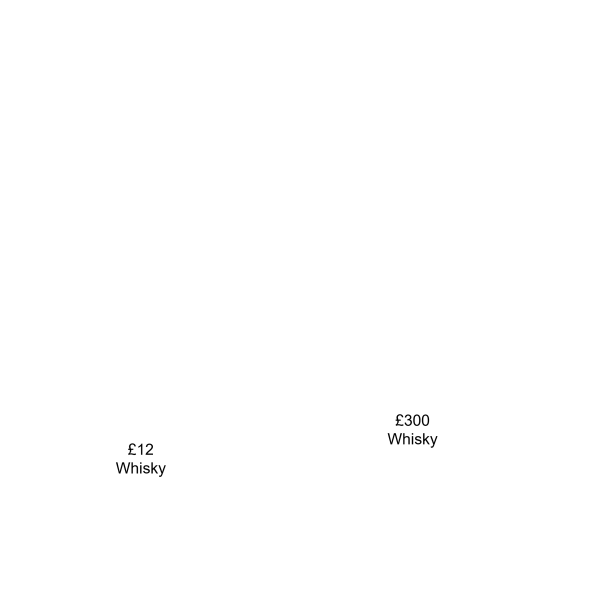
The uncertainty-complexity matrix is a useful tool for identifying different value streams in the organisation. Each quadrant of the matrix may be defined as follows:
- At the low-complexity and low uncertainly quadrant we have commodities that compete mainly on price where the organisation need to work efficiently like well-oiled clockwork to ensure that the unit cost thus price can be kept to a minimum. Examples include light bulbs, clothes pegs, etc. as well as tradable commodities.
- At the high-complexity and high-uncertainty quadrant, we have capital goods where fitness for purpose is of utmost importance. Here the organisation needs to ensure that it works effectively to deliver a product that is fit for purpose, on budget, on time. Examples include oil platform construction, military aircraft.
- At the low-complexity and high-uncertainty quadrant we have jobbing and fashion products where responsiveness and timeliness are key competitive factors. Here the organisation needs to be agile and responsive to meet customers and markets specific requirements and timescales.
- At the high-complexity and low-uncertainty quadrant we have consumer durables where combination of price, quality and delivery are key competitive factors. Here organisation needs to be good at understanding market characteristics and deliver their specific value proposition.
Some guidance for using the uncertainty-complexity matrix
1. Identify and Categorize Value Streams:
- List All Value Streams: Begin by identifying all the value streams in your organization. A value stream represents the end-to-end processes involved in delivering a product or service to the customer.
- Group Similar Products or Services: Categorize your products or services based on their characteristics, such as product complexity, customization, and the certainty of demand.
2. Assess Complexity:
- Define Complexity: Consider the technical intricacy, number of components, and the level of customization involved in each value stream.
- Assign Complexity Levels: Assign a complexity level (low or high) to each value stream based on the degree of customization, the number of processes involved, and the level of expertise required.
3. Assess Uncertainty:
- Define Uncertainty: Consider the predictability of demand, market stability, and variability in customer requirements for each value stream.
- Assign Uncertainty Levels: Based on the predictability of demand, the frequency of changes in customer preferences, and market volatility, assign an uncertainty level (low or high) to each value stream.
4. Plot on the Matrix:
- Create the Matrix: Draw a matrix with four quadrants, with complexity on one axis (low to high) and uncertainty on the other axis (low to high).
- Place Value Streams: Based on its assessed levels of complexity and uncertainty, position each value stream in the appropriate quadrant.
5. Analyse Each Quadrant:
- Low Complexity, Low Uncertainty (Commodities): Identify value streams that belong here. These typically involve standardized products competing on price and requiring efficient processes.
- High Complexity, High Uncertainty (Capital Goods): Identify value streams that belong here. These typically involve custom-engineered solutions, and the key success factors are effectiveness, budget adherence, and timely delivery.
- Low Complexity, High Uncertainty (Fashion/Jobbing Products): Identify value streams that belong here, typically involving products or services where agility and responsiveness are crucial due to changing customer demands.
- High Complexity, Low Uncertainty (Consumer Durables): Identify value streams that belong here. These typically involve durable goods, where a combination of price, quality, and delivery time are the main competitive factors.